Tharkian combat-based rank and honor
A Princess of MarsTharkian combat-based rank and honor organizes status through demonstrated prowess and the community’s acknowledgment of it. A victory can change a captive into a chieftain, a warrior’s weapons and ornaments can become the victor’s insignia, and the same combat culture can shape rules for duels and succession. Its customs both constrain violence and reward it, making martial reputation a source of personal privilege and political legitimacy.
Status Earned in Combat
The system first becomes legible to John Carter through the warriors’ response to his unexpected strength and agility. After he strikes a warrior who has roughly forced him to his feet, the assembled Martians answer not with revenge but with astonishment, laughter, and applause. Carter initially misunderstands the response; he later learns that the display is an uncommon expression of approval. The episode establishes that public recognition matters alongside physical victory: the act changes how the gathering regards him, even before he understands the rules behind that change.
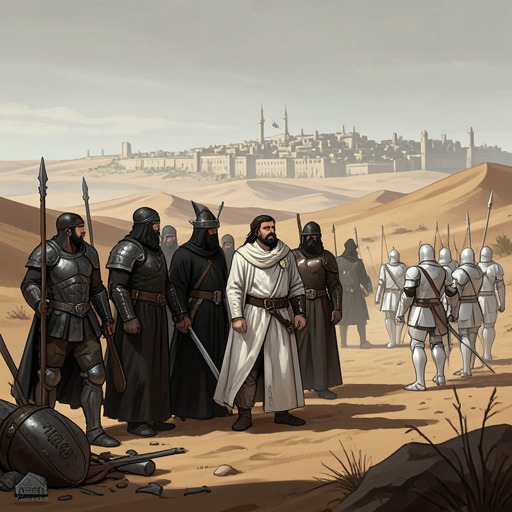
The consequence becomes explicit when a warrior brings Carter the arms, equipment, and ornaments taken from the opponent who died in their earlier encounter. Carter realizes that his blow had killed the man and that the objects he carries mark the victory. Under the community’s customary justice, he receives the dead warrior’s position and the respect due a conqueror. The transfer is not merely a change of possessions: it explains why Carter has been allowed to bear arms and why he is treated with unusual freedom in the audience chamber.
The new standing remains conditional. Tars Tarkas explains that Carter is to be respected as a Tharkian chieftain until they reach Tal Hajus, but that the higher chiefs remain responsible for delivering him to their ruler. Admission to the community depends on whether Tal Hajus considers Carter worthy of service. The custom therefore confers real rank without making the stranger secure: martial achievement earns recognition, while a superior ruler retains power to determine whether that recognition becomes full membership.
Rank, Names, and Material Insignia
Carter’s rank can be counted. Sola tells him that the warrior whose metal he now carries had risen through promotions and kills to a position near Tars Tarkas, second only to Lorquas Ptomel. Carter stands eleventh, with ten chieftains above him. His place is legible through the captured equipment and through the community’s ranking of the warrior he defeated; victory transfers both a material sign and an established position in the hierarchy.
The names used for Carter likewise preserve the record of combat. Some warriors call him Dotar Sojat, combining the surnames of the two chieftains whose metal he wears because he killed them in fair fight. The title turns victories into a public identity: his standing is not an abstract claim but a history carried in his name and regalia. The custom makes conquest visible, allowing others to recognize the source of his authority even when they do not share his background.
Rank can rise further, but not through private assertion alone. Carter asks what would follow if he killed Lorquas Ptomel. Sola says he would become first, but only if the entire council wills that Lorquas meet him in combat, or if Lorquas attacks him and Carter kills him in self-defense. The rule makes advancement contingent on recognized circumstances and collective authorization. An individual may possess the ability to challenge a superior, yet the community’s decision determines whether that encounter is a legitimate route to the highest place.
Rules Governing Challenges
Combat status also prescribes how a challenge must be met. When Zad strikes Carter’s thoat, Carter understands that he must answer with Zad’s chosen weapon or one of lesser rank. Because Zad has drawn his longsword, Carter may use that sword, a shortsword, a dagger, a hatchet, or his fists; he may not use a firearm or spear against an opponent armed only with a sword. The rule limits the advantage a challenger can claim and defines fair combat through a shared hierarchy of weapons.
Carter chooses the longsword rather than a lesser weapon because Zad prides himself on his skill with it. His choice makes the encounter a test on the opponent’s preferred ground, not simply an attempt to exploit the rules. The duel delays the march for an hour, and the community gathers around a clear space roughly one hundred feet in diameter. The public setting gives the contest witnesses, while the regulated choice of weapon makes the outcome answerable to a recognized standard.
That standard permits lethal competition while distinguishing it from unrestricted attack. Carter’s earlier killing earns him the dead man’s equipment and rank; his later encounter with Zad is framed as a fair fight governed by limits on weapon choice. In both cases, combat becomes socially consequential because the community can classify it: as a victory that transfers standing, or as a challenge conducted within accepted rules.
Leadership and Political Legitimacy
The connection between combat and authority becomes decisive when Carter argues before the Thark council that Tal Hajus is unfit to rule. He contrasts the ruler’s absence from the recent fighting with his violence against defenseless women and children, then points to Tars Tarkas as a warrior and leader worthy of the title of Jeddak. Carter’s appeal works within the community’s own esteem for bravery: the question is not only who holds power, but whether the ruler has demonstrated the qualities that make that power legitimate.
The assembled chieftains respond with deep applause to the proposal that Tars Tarkas become Jeddak. Carter presses the point by calling Tal Hajus a coward and arguing that a brave ruler would invite Tars Tarkas to combat. The council’s approval and the demand that Tal Hajus prove his fitness show that leadership is subject to a martial test, but also that the test is political. A fight does not automatically settle succession; the council must command that the challenge occur.
The hierarchy thus joins individual prowess to collective judgment. A kill can elevate a warrior, but the highest offices depend on custom and communal authorization. Carter’s speech uses the system’s own measure of courage to challenge Tal Hajus, turning combat honor into a standard by which rule may be questioned rather than merely obeyed.
Honor, Violence, and Reinterpretation
The customs reward force, yet the novel places that reward beside practices that suggest another measure of authority. Carter trains his thoats through a combination of establishing mastery and gradually winning their confidence, rather than relying on the customary blows used when the animals resist. They come to follow him and respond readily to his commands. When Tars Tarkas asks how he has achieved this, Carter answers that kindness benefits a warrior because reliable mounts improve performance in battle. He persuades Tars Tarkas to learn the method, and the training is later demonstrated to Lorquas Ptomel and the assembled warriors. The resulting change in the mounts’ docility improves the precision and speed of military movements, and Lorquas presents Carter with a massive gold anklet as recognition of his service.
This episode does not abolish the combat hierarchy: Carter’s humane treatment gains acceptance partly because it makes the horde more effective. Yet the gift shows that recognized merit need not arise only from killing. Practical service can also earn a visible token of esteem, while care for animals proves compatible with a warrior’s competence. The system’s honors remain rooted in communal value, but what counts as valuable can be widened by a result the community can see.
The resulting code is both a restraint and a sanction. It regulates who may challenge whom, what weapons may be used, and when a victory changes rank; it also makes killing a means of acquiring titles, insignia, and political influence. Carter learns to navigate those rules while asserting standards of protection and kindness that the Tharks do not ordinarily prize. The tension gives combat honor its significance: it is not simply a ladder of strength, but a social order whose authority depends on public recognition and whose values can be contested from within.